

What is the 16-Point Maladaptive Daydreaming Scale?
The 16-Point Maladaptive Daydreaming Scale (MDS-16) is a validated questionnaire developed by researcher Eli Somer and colleagues to measure the presence and severity of maladaptive daydreaming. It contains 16 questions across four domains: yearning to daydream, impairment in daily life, physical movements during daydreaming, and use of music as a trigger. A score of 40 or above suggests probable maladaptive daydreaming.
Maladaptive daydreaming (MD) shares many traits with common mental disorders such as inattentive ADHD and OCD.
To help avoid misdiagnosis and better pinpoint the presence of MD as a mental illness, researchers have created the 16-point maladaptive daydreaming scale (MDS-16) which helps accurately measure and diagnose the condition.
Let’s take a closer look at the MDS-16 and how you can use this to learn more about your own daydreaming tendencies.
What Is the 16-Point Maladaptive Daydreaming Scale (MDS-16)?
The MDS-16 was developed in 2016 by a worldwide team of researchers led by the prominent maladaptive daydreaming clinician Eli Somer.
The original version of the scale had 14 questions and was found to be an accurate and reliable measure of the condition.
As research into MD continued, it was discovered that the use of music to facilitate immersion in daydreams was a prominent feature in almost all individuals with MD.
The scale was revised to include two questions relating to the use of music, creating the MDS-16 as it is used today.
What Questions Are on the MDS-16?
The 16 questions on the MDS-16 scale assess an individual’s daydreaming tendencies across various dimensions:
- Triggers to daydreaming
- Physical movements that accompany daydreaming
- How daydreaming feels
- How interruptions or being denied the chance to daydream feel
- The impact of daydreaming on daily life
The 16 questions can be grouped together to create four key factors that differentiate MD from normal or non-pathological daydreaming. These are:
- Yearning: The urge to spend time daydreaming and the uncontrollable thoughts it creates
- Impairment: The level of emotional distress and daily impairment created by daydreaming
- Kinesthesia: The use of movement to facilitate daydreaming
- Music: The use of music to trigger or deepen immersion
Curious how you would score on the 16-Point Maladaptive Daydreaming Scale? If so, you can take our free online Maladaptive Daydreaming Scale Test.
How Is the MDS-16 Scored — and What Does Your Score Mean?
Each question on the MDS-16 is answered on an 11-point scale. A score of 40 or above when adding up these scores would indicate probable Maladaptive Daydreaming.
While the MDS-16 has good reliability and has been tested extensively across various languages and cultures, it’s still important to remember that MD isn’t an officially recognized mental health condition, so results on the scale can’t be taken as a diagnosis.
Still, taking the MDS-16 could certainly help you assess whether your daydreaming habits are problematic, help you understand your condition, and indicate whether it would be wise to seek treatment.
Does a High MDS-16 Score Correlate With Other Mental Health Conditions?
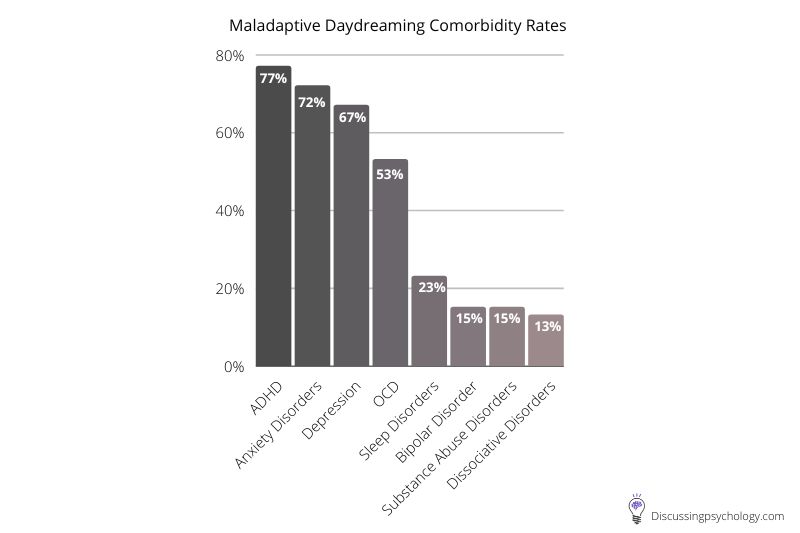
MD is known to be frequently experienced alongside other mental health conditions such as various anxiety disorders and depression.
Indeed, scores on the MDS have been shown to correlate with various other conditions and factors, including:
- Depression
- ADHD
- Dissociative experiences
- Past traumatic experiences
- Poor overall mental health
- Alexithymia— difficulty feeling and describing emotions
- Maladaptive personality traits, in particular psychoticism, antagonism, detachment from other people and frequency of experiencing negative emotions
- Insecure attachment style— indicating a fractured or inconsistent relationship to one’s primary caregiver as a child, leading to anxious behavior patterns in adult romantic relationships
- Feelings of shame
Each of these correlations opens up fascinating avenues for future research. Does MD cause or result from poor mental health?
How do negative personality traits link to the tendency (and content) of excessive daydreaming? If one struggles to experience emotions fully, does daydreaming make this easier?
Does the MDS-16 Work Across Different Cultures?
The MDS-16 has been tested globally in various languages and cultures.
While the four-factor, sixteen-question model of MD outlined above fits with the data in all studied countries, the extent to which yearning was a factor varied greatly between cultures.
This implies that the concept of daydreaming may have different meanings in different cultures.
Some cultures, for example, may view daydreaming as shameful or childish, while others value it as a source of comfort and inspiration.
These differing perspectives would affect how being addicted to daydreaming impacts a person’s view of themselves and the overall distress the condition causes.
What Is the Next Step If You Score High on the MDS-16?
The development and testing of the 16-point maladaptive daydreaming scale is significant in that it shows MD to be a phenomenon that occurs around the world in a predictable way with symptoms, traits, and risk factors reliably presenting in the same ways.
Once our understanding of MD solidifies, attention can turn to finding an effective form of treatment to help people break free of their compulsion to daydream and the emotional pain it causes.
FAQ
The MDS-16 is a 16-question psychological assessment developed in 2016 by Somer et al. to identify symptoms of maladaptive daydreaming. It asks respondents to rate experiences on a scale of 0–100% across factors including distress, compulsion, interference with life goals, and music dependency. It is free to take and all results remain anonymous.
No. The MDS-16 test is not an official diagnostic tool and should not be used as a substitute for a professional medical opinion. If you suspect you may have maladaptive daydreaming or require a diagnosis, you should consult a trained healthcare or medical practitioner.
The test has 16 questions, each answered on a scale from 0% to 100% in 10% intervals, where 0% means never and 100% means all of the time. Each question asks you to reflect on your daydreaming experiences over the past month. The test is free and results are kept anonymous.
The MDS-16 measures 16 dimensions of daydreaming behavior including: how much music triggers daydreaming, the urge to return to interrupted daydreams, physical movements during daydreaming, distress about time spent daydreaming, interference with daily tasks and life goals, difficulty controlling daydreaming, and how enjoyable or comforting daydreams feel.
The MDS-16 was developed in 2016 by Somer et al. and is associated with the International Consortium for Maladaptive Daydreaming Research. It was specifically designed to distinguish maladaptive daydreaming from normal daydreaming using a structured, repeatable assessment format.
- Metin, S., Gocmen, B., & Metin, B. (2022). Turkish validity and reliability study of Maladaptive Daydreaming Scale. Psychiatry and Behavioral Sciences, 12(1), 1. https://doi.org/10.5455/pbs.20210907111754
- Schimmenti, A., Sideli, L., La Marca, L., Gori, A., & Terrone, G. (2019). Reliability, validity, and factor structure of the Maladaptive Daydreaming Scale (MDS–16) in an Italian sample. Journal of Personality Assessment, 102(5), 689–701. https://doi.org/10.1080/00223891.2019.1594240
- Soffer-Dudek, N., Somer, E., Abu-Rayya, H., Metin, B., & Schimmenti, A. (2021). Different cultures, similar daydream addiction? An examination of the cross-cultural measurement equivalence of the Maladaptive Daydreaming Scale. Journal of Behavioral Addictions, 9(4), 1056–1067. https://doi.org/10.1556/2006.2020.00080
- Somer, E., Lehrfeld, J., Bigelsen, J., & Jopp, D. (2016). Development and validation of the Maladaptive Daydreaming Scale (MDS). Consciousness and Cognition, 39, 77–91. https://doi.org/10.1016/j.concog.2015.12.001
- Uslu, H. (2015). Understanding the relationship between media use and maladaptive daydreaming. Master’s Thesis. Georgetown University, Washington D.C. https://www.proquest.com/openview/38fa5a28cc18376cf2d09aaf5340defd/1?pq-origsite=gscholar&cbl=18750