

The rise in the use of nitrous oxide is raising concern. But nitrous oxide use is “innocent,” right? The legality and easy accessibility of this substance, however, leads people to underestimate its risk.
Evidence suggests that the use of nitrous oxide may have various repercussions, not just in terms of health but also socially and financially.
In this article, all things nitrous oxide will be discussed, including how it’s used, the demographics of users, and the risks nitrous oxide inhalation poses.
Please note that inhalation and recreational use of nitrous oxide can pose significant risks to your health. We strongly recommend you avoid using nitrous oxide without proper medical supervision or consultation with a licensed health professional.
Nitrous Oxide: What is it?
Nitrous oxide is a colorless, odorless gas that elicits a disorienting ‘high’ when inhaled. Although seen as relatively low-risk, nitrous oxide abuse can have many short- and long-term consequences, from frostbite to brain cell death.
Nitrous oxide typically comes in metal canisters and gas tanks. Dentist Horace Wells first used the substance in 1844 for a dental extraction. Since then, it has been used as an anesthetic drug in minor medical procedures.
Nitrous oxide is also a mixing and foaming agent used in the production of whipped cream and a fuel booster in motor vehicles.
During recreational use, the canisters are ‘cracked.’ The user then inhales the nitrous oxide gas released.
This sets off a neurochemical response, blocking specific neurotransmitters involved in anxiety and releasing norepinephrine, a “feel-good” hormone.
Notably, when inhaled, nitrous oxide gas makes your voice deeper, however this is only for a very short duration of time.
To date, most drug tests do not detect nitrous oxide within the body.
Nitrous Oxide Abuse: A Closer Look
Street Names of Nitrous Oxide
Nitrous Oxide is most commonly known as laughing gas, but it has acquired various other street names over the years, including:
- Nitro
- N2O
- NOS
- Whippets
- Hippy crack
- Balloons
- Nangs
- Buzz bomb
Buying Nitrous Oxide
In the USA, UK, and Australia, nitrous oxide is legal to purchase and possess for those over the age of 18. This is primarily due to its use in the hospitality and healthcare industries.
However, many regions across these countries have also made it illegal for individuals under 18 years of age to purchase nitrous oxide.
If someone is caught supplying nitrous oxide illegally, the penalty can be up to seven years’ prison time in the USA, six months in the UK, and a hefty $5000 fine in Australia.
You can buy nitrous oxide canisters online, making the substance highly accessible for recreational use. Nevertheless, evidence suggests that this wasn’t the most common source in 2014; rather, friends were.
How Do You Consume Nitrous Oxide?
Nitrous oxide is inhaled. Users will typically open or ‘crack’ the canister before transferring the nitrous oxide gas into a container, most often a balloon.
Inhaling gas straight from the cannister can be extremely dangerous because it can cause oxygen deprivation and frostbite.
Other high-risk methods of inhalation include:
- Filling an enclosed space with nitrous oxide
- Placing a bag filled with nitrous oxide over your head
- Inhaling through a mask attached to a nitrous oxide tank.
The above methods of nitrous oxide abuse can be very dangerous and should not be attempted. We strongly discourage any form of nitrous oxide use without consultation or supervision from a licensed health professional.

Who Typically Uses Nitrous Oxide?
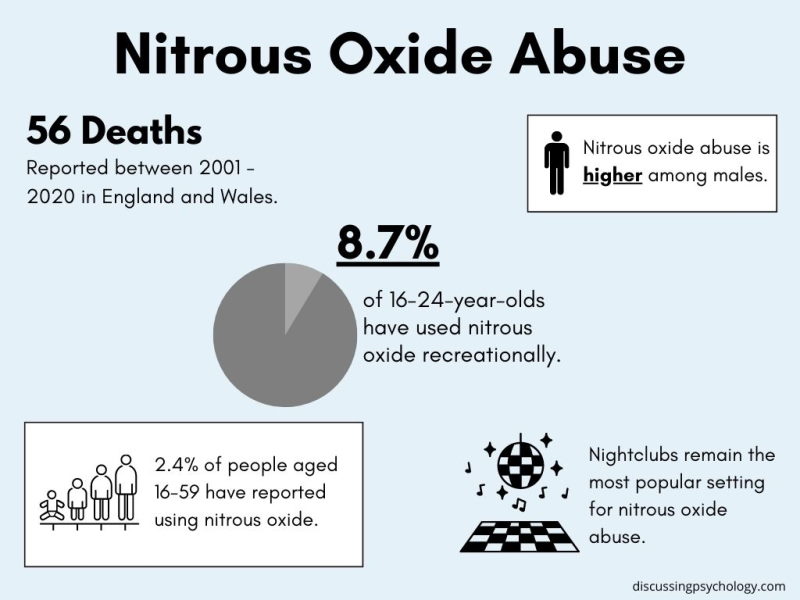
Evidence suggests that nitrous oxide is the eighth most commonly-used substance in the UK. In terms of demographics, nitrous oxide use is more likely among:
- Men (2.9%) than women (1.8%) in the broad age range of 16 to 59 years old.
- Those who attend clubs versus non-clubbers, with percentages of 9.4% and 3.0%, respectively.
The study found that males aged 16 –- 25 attending clubs were the most likely demographic group to use nitrous oxide recreationally.
Related: Young people may be more likely to abuse nitrous oxide when under the influence of alcohol or peer-pressure. In other cases, it could be a sign of deeper mental health issues.

Learn more in our Guide on Mental Health Resources for College Students.
Where Is Nitrous Oxide Used?
Studies demonstrate a link between parties and nitrous oxide use, with 83% of respondents consuming nitrous oxide at house parties, 74% at festivals, and 43% at clubs.
However, 50% of participants in this survey reported using nitrous oxide at home.
A Global Drug Survey reports similar findings:
- House parties (70%)
- Festivals (48%)
- Home (43%)
- Nightclubs (28%)
Is Nitrous Oxide Used Alongside Other Drugs?
Nitrous oxide is frequently used in combination with other drugs as well as alcohol.
When used in conjunction with psychedelics like psilocybin (magic mushrooms) and LSD (acid), it supposedly enhances the effects.
Research highlights the link between nitrous oxide use and cannabis in adolescents; cannabis users had significantly higher lifetime nitrous oxide use than non-cannabis users. Frequent binge drinking showed a similar relationship.
Despite this, there is no current evidence to suggest that mixing N2O with other drugs exacerbates health risks. But it is widely assumed that mixing N2O with other drugs may elevate blood pressure, alter heart rate, and cause additional heart strain.
Can Nitrous Oxide Use Lead To Injuries?
A 2016 international survey reported that only 1.2% of N2O users suffered from an accidental injury. However, injuries were related to the number of nitrous oxide doses per session, with more ‘hits’ increasing the likelihood of injuries.
The Alcohol and Drug Foundation proposes that inhaling nitrous oxide straight from the canister can cause lung ruptures due to the pressure of the gas within the canister.
Evidence also suggests that accidents like tripping and falling can occur if you inhale nitrous oxide while standing up.
Immediate Effects of Nitrous Oxide Abuse
Nitrous oxide kicks in seconds after inhalation and lasts between 1–5 minutes. People using nitrous oxide report the following immediate effects:
- A quick feeling of euphoria
- Floating sensation
- Fits of laughter
- Relaxation
- Calmness
- Sound distortions
- Hallucinations
While the distortive effects may sound appealing to some, there are a considerable number of short-term (and long-term!) health risks.
The Dangers of Nitrous Oxide Abuse

Nitrous oxide abuse poses many serious risks, yet the substance is seen as relatively innocent by adolescents and not as dangerous as cannabis or alcohol use.
Health Risks on the Body
Nitrous oxide recreational use can have various short-term side effects, such as the following:
- Vomiting
- Nausea
- Fatigue
- Dizziness
- Shivering
- Sweating
Some people are allergic to nitrous oxide; use can lead to wheezing and other breathing difficulties, hives, a fever, and chills. It’s vital to seek medical help immediately if any of these symptoms manifest.
Most would view these effects as unpleasant, but the long-term effects pose more of a health risk. Prolonged use of N2O can cause brain cell death, memory loss, and vitamin B12 deficiency, which can lead to nerve damage.
It’s also possible to experience incontinence, limb spasms, numbness of the limbs, and disturbance of the reproductive system due to long-term nitrous oxide use.
Mental Health Risks
Evidence suggests that several psychiatric symptoms may occur as a result of B12 deficiency from nitrous oxide use, including
- Personality changes
- Emotional disorders (such as anxiety, depression, and mania)
- Impulsive/aggressive behaviors
- Delusions
- Other psychotic symptoms
Therefore, nitrous oxide recreational use poses a significant risk to mental health. Nitrous oxide may also lead to psychological dependence, potentially resulting in long-term addiction.
Social Risks
As with any drug use, there is a social stigma associated with nitrous oxide. The UK Parliament highlights several social concerns, such as:
- Potential increase in the risk of anti-social behavior as a result of nitrous oxide use
- Public disturbance when individuals consume nitrous oxide in public spaces
- Littering of empty canisters
However, it’s important to note that evidence suggests that social stigma around religion, identity, and discrimination may lead to an increased likelihood of risk-taking behaviors like binge drinking and nitrous oxide abuse and dependency.
This may suggest a bidirectional relationship between nitrous oxide use and social risks.
Financial Risks
Nitrous oxide abuse doesn’t just have an impact on your health and social standing; your finances can take a considerable hit, too.
While nitrous oxide is typically considered cheap, the cost of frequent and heavy use can quickly accumulate. Some nitrous oxide users report inhaling 100 canisters in a single session.
Considering a box of 100 canisters typically costs about $60 USD, nitrous oxide inhalation can rapidly become an expensive habit.
Treatment for Nitrous Oxide Abuse
The main treatment methods for nitrous oxide abuse are talking therapy, prescription medications, and local support services.
Talking Therapy
Talking therapy can assist in nitrous oxide abuse recovery in various ways. Together with a therapist or counselor, you can work through any unresolved traumas and emotional difficulties that may have led you to nitrous oxide use.
Therapy will also help you become more aware of the triggers that increase the risk of relapses, like stress and environmental cues.
Cognitive Behavioural Therapy (CBT) is the most commonly used talking therapy approach for substance abuse. CBT is a short-term therapy that helps you identify the negative thoughts and feelings that trigger N2O use.
Prescription Medication
Another treatment option is medications prescribed by your doctor.
Medicine has shown some promise in treating nitrous oxide abuse, particularly naltrexone, which appears to weaken nitrous oxide cravings and lessen the severity of harm from chronic use.
Local Support Services
There’s some evidence to suggest that the support of untrained peers can have a positive impact on substance abuse recovery.
Ask your doctor about the local support services available. They will be able to direct you to relevant services.
Summary
Nitrous oxide is a popular recreational substance for house parties and festivals, most often used among young adults and teenagers.
People underestimate the harmful effects of nitrous oxide abuse. However, the risks are very real. Nitrous oxide abuse can take a toll on your body, mind, and finances.
If you are falling victim to nitrous oxide abuse, seek the support of a mental health professional or your doctor.
- Gillman, M. A. (2019). Mini-review: A brief history of nitrous oxide (N2O) use in neuropsychiatry. Current Drug Research Reviews, 11(1), 12–20. https://doi.org/10.2174/1874473711666181008163107
- Re-Solv. (2021, September 24). Solvent abuse, nitrous oxide and the law. https://www.re-solv.org/solvent-abuse-law/
- Rough, E., & Brown, J. (2020, July 20). Nitrous oxide: No laughing matter? UK Parliament: House of Commons Library. https://commonslibrary.parliament.uk/nitrous-oxide-no-laughing-matter/#:~:text=Supplying%20nitrous%20oxide&text=Even%20if%20someone%20advertises%20the,prison%20or%20an%20unlimited%20fine.
- Government of South Australia: Attorney-General Department. (2021, December 8). Nitrous oxide regulations. https://www.agd.sa.gov.au/law-and-justice/legislation/nitrous-oxide-regulations#:~:text=to%20the%20public.-,Penalties,be%20fined%20up%20to%20%245%2C000.
- Kaar, S. J., Ferris, J., Waldron, J., Devaney, M., Ramsey, J., & Winstock, A. R. (2016). Up: The rise of nitrous oxide abuse. An international survey of contemporary nitrous oxide use. Journal of Psychopharmacology, 30(4), 395–401. https://doi.org/10.1177/0269881116632375
- van Amsterdam, J., Nabben, T., & van den Brink, W. (2015). Recreational nitrous oxide use: Prevalence and risks. Regulatory Toxicology and Pharmacology, 73(3), 790–796. https://doi.org/10.1016/j.yrtph.2015.10.017
- Drug Science. (2022, July 1). Nitrous oxide (laughing gas). https://www.drugscience.org.uk/drug-information/nitrous-oxide/#1614731712738-d087d77d-4bca
- Sheldon, R., Reid, M., Schon, F., & Poole, N. (2020). Just say N2O – Nitrous oxide misuse: Essential information for psychiatrists. BJPsych Advances, 26(2), 72–81. https://doi.org/10.1192/bja.2019.57 GDS2015 findings: Nitrous oxide. (2015, June 7). [Video]. YouTube. https://www.youtube.com/watch?v=T1i0a1onUhY
- van den Toren, S. J., van Grieken, A., & Raat, H. (2021). Associations of socio-demographic characteristics, well-being, school absenteeism, and substance use with recreational nitrous oxide use among adolescents: A cross-sectional study. PLOS ONE, 16(2), e0247230. https://doi.org/10.1371/journal.pone.0247230
- Alcohol and Drug Foundation. (2021, November 10). What is nitrous oxide? https://adf.org.au/drug-facts/nitrous-oxide/#:~:text=How%20is%20it%20used%3F,or%20directly%20into%20the%20mouth.&text=Inhaling%20nitrous%20oxide%20produces%20a,a%20short%20period%20of%20time.
- Talk to Frank. (n.d.). Nitrous oxide. https://www.talktofrank.com/drug/nitrous-oxide#how-it-feels
- Nabben, T., Weijs, J., & van Amsterdam, J. (2021). Problematic use of nitrous oxide by young Moroccan–Dutch adults. International Journal of Environmental Research and Public Health, 18(11), 5574. https://doi.org/10.3390/ijerph18115574
- Chen, T., Zhong, N., Jiang, H., Zhao, M., Chen, Z., & Sun, H. (2018). Neuropsychiatric symptoms induced by large doses of nitrous oxide inhalation: A case report. Shanghai Arch Psychiatry, 30(1), 56–59. http://dx.doi.org/10.11919/j.issn.1002-0829.217084
- Winstock, A. R., & Ferris, J. A. (2019). Nitrous oxide causes peripheral neuropathy in a dose dependent manner among recreational users. Journal of Psychopharmacology, 34(2), 229–236. https://doi.org/10.1177/0269881119882532
- Hoffman, M. (2021). Counseling and substance abuse disorders. WebMD. https://www.webmd.com/mental-health/addiction/counseling-and-addiction-how-therapy-can-help
- Ickowicz, S. Brar, R. & Nolan, S. (2020). Case study: Naltrexone for the treatment of nitrous oxide use Journal of Addiction Medicine, 14(5), e277−79. https://doi.org/10.1097/ADM.0000000000000642
- Tracy, K., & Wallace, S. P. (2016). Benefits of peer support groups in the treatment of addiction. Substance Abuse Rehabilitation, 29(7), 143−154. https://doi.org/10.2147/SAR.S81535


